
Who Gets the Last Word?
Speaking about adoption online without getting burned
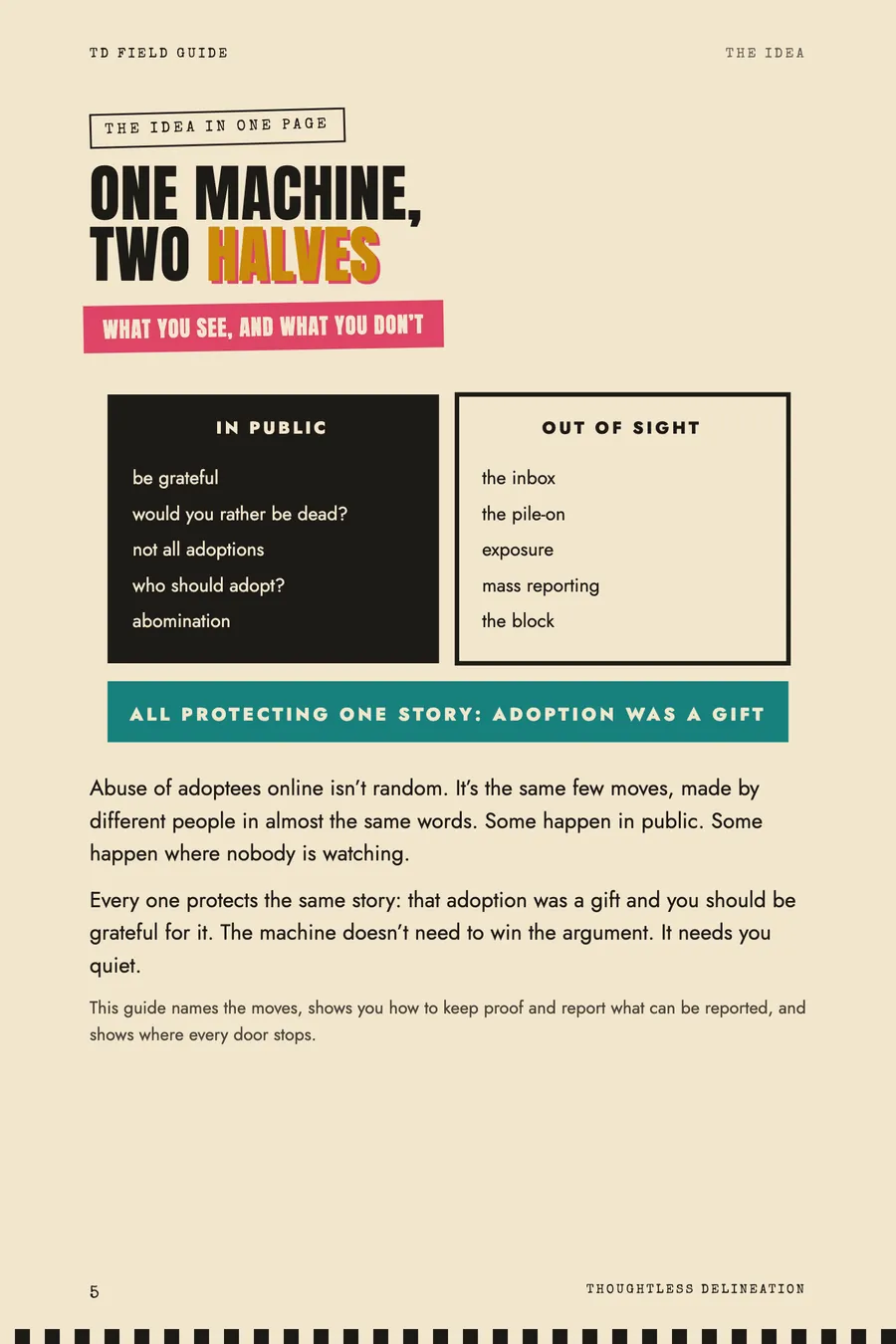
If you talk about adoption online as someone who lived it, you’ll meet the same few replies again and again. “Be grateful.” “Would you rather be dead?” Then, sometimes, worse. This guide is about speaking anyway: name the moves, keep the proof, report what can be reported, and decide for yourself when to speak.
Look inside
Who it’s for
Adoptees and first mothers
You don’t have to win the argument. This guide shows how to keep proof before you reply, report what fits a rule, and look after yourself when a thread turns.
Friends and allies
When an adoptee is piled on, the people watching decide whether to speak. How to back them in public without talking over them.
Adoptive parents
Your child’s adoption story is theirs. Why arrival videos and “gotcha day” posts matter later, and how to take them down.
Group admins and moderators
The unpaid front line. Rules on screenshots and outing members, support lines to pin, and limits for the people who carry everyone else.
What’s inside
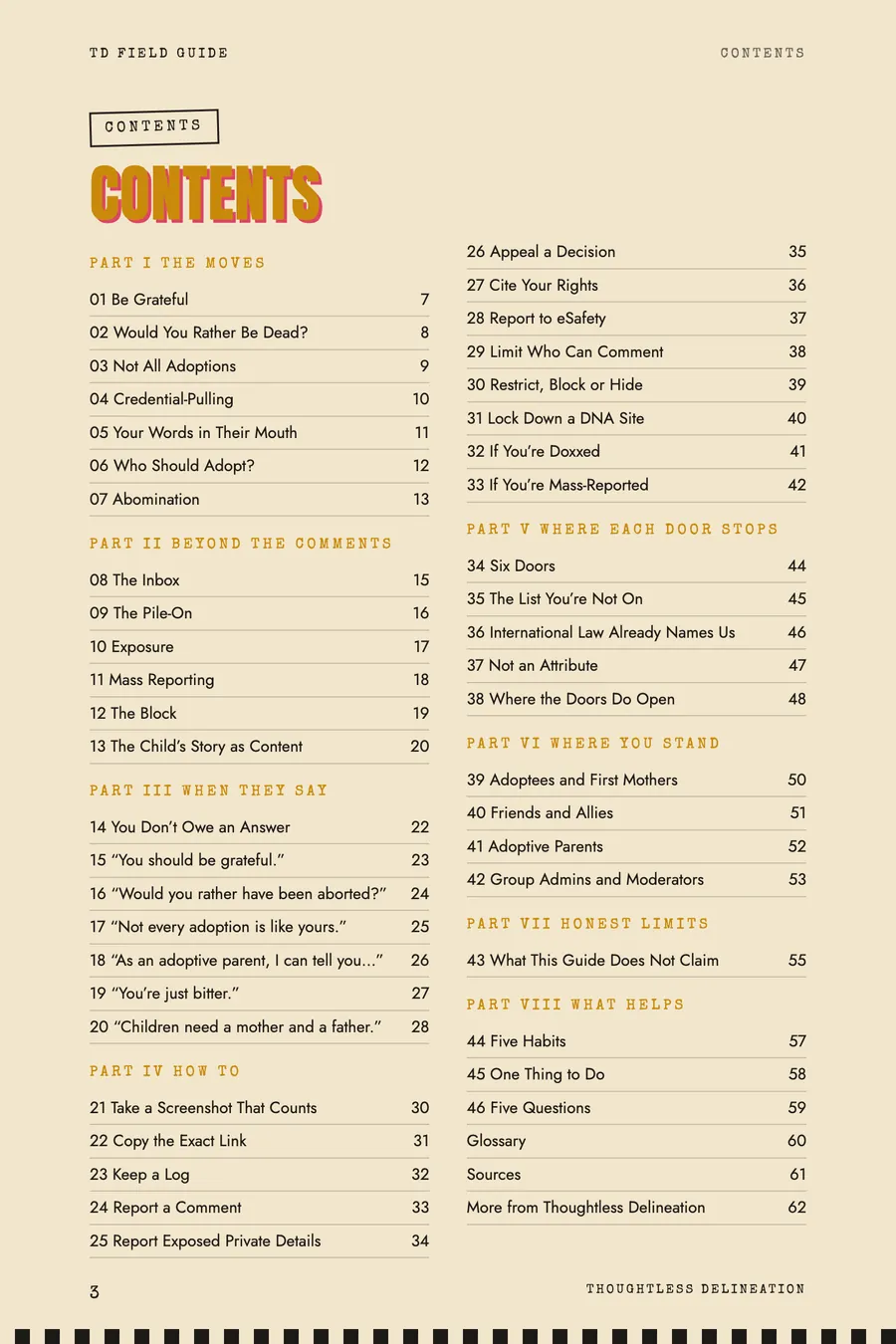
Eight parts, from the moves to what helps. Each page is one idea, and Part IV is all step-by-step how-tos.








- The moves (pp. 6–13). Be grateful; would you rather be dead?; not all adoptions; credential-pulling; your words in their mouth; who should adopt?; abomination.
- Beyond the comments (pp. 14–20). The inbox, the pile-on, exposure, mass reporting, the block, and the child’s story as content.
- When they say (pp. 21–28). Six lines you’ll hear, what each is doing, what it wants from you, and what you could say back. Or not.
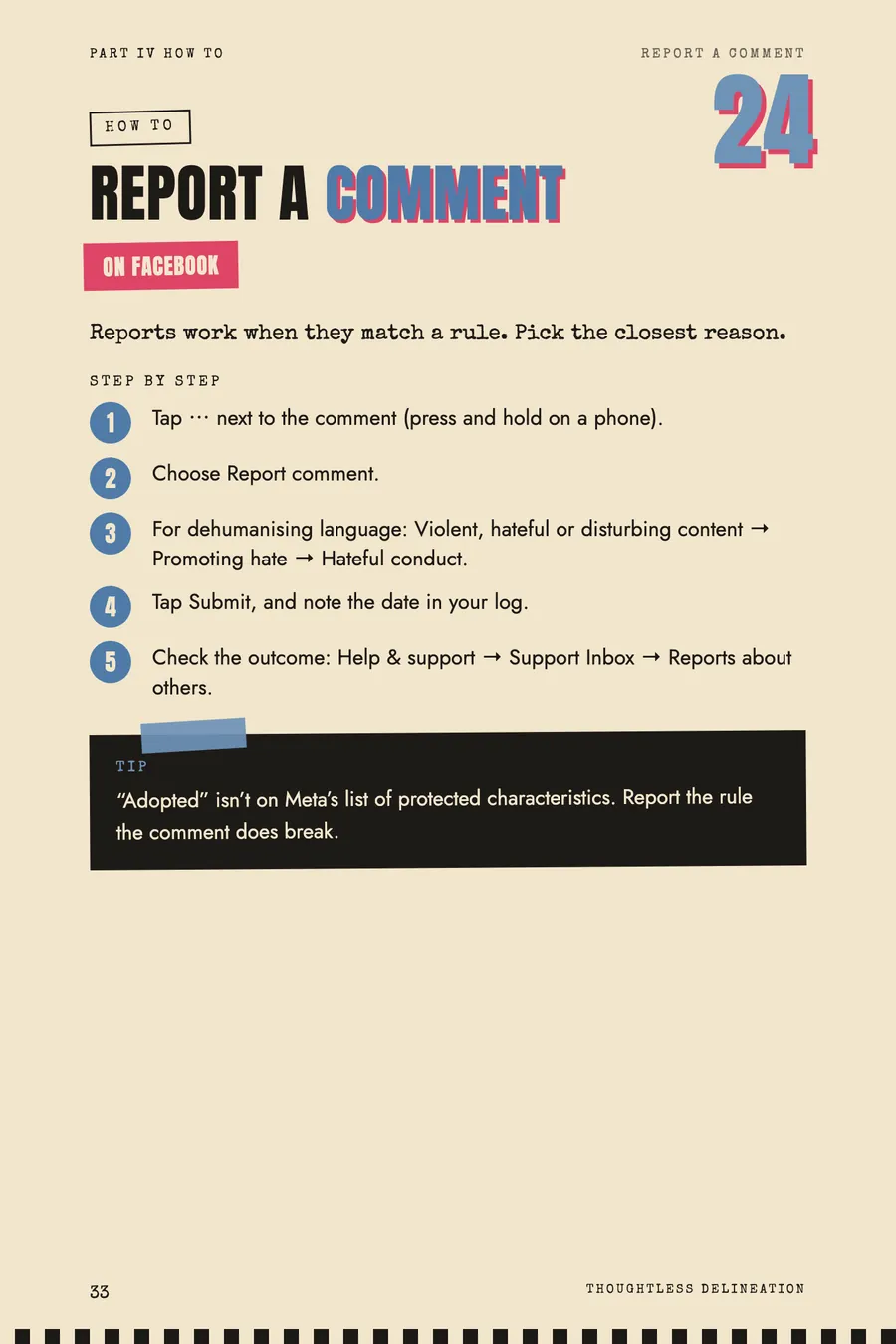
- How to (pp. 29–42). Thirteen step-by-step pages: screenshots that count, the exact link, a log, reporting, appeals, citing your rights, eSafety, limiting comments, restricting and blocking, DNA sites, doxxing and mass reporting.
- Where each door stops (pp. 43–48). Six doors, the list you’re not on, the international law that already names adopted people, and where the doors do open.
- Where you stand (pp. 49–53). Adoptees and first mothers, friends and allies, adoptive parents, group admins.
- Honest limits (pp. 54–55). What the guide does not claim.
- What helps (pp. 56–59). Five habits, one thing to do this week, and five questions to ask yourself.
It closes with a glossary, a sources list, and links to more of Shane Bouel’s work.
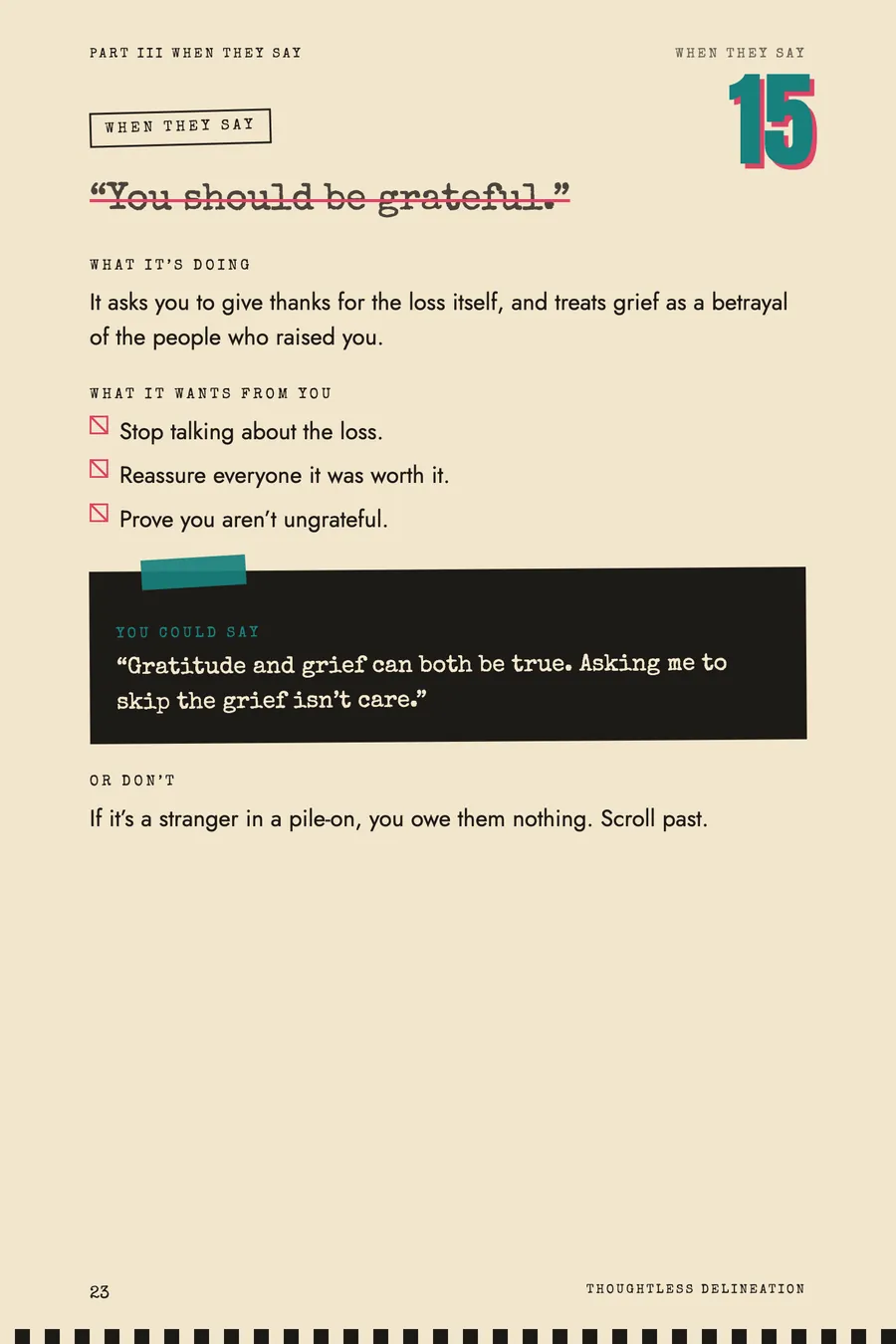
Sample page: “You should be grateful.”
What it’s doing
It asks you to give thanks for the loss itself, and treats grief as a betrayal of the people who raised you.
You could say
“Gratitude and grief can both be true. Asking me to skip the grief isn’t care.”
Or don’t
If it’s a stranger in a pile-on, you owe them nothing. Scroll past.
Questions
Why can’t abuse of adoptees just be reported as hate?
Platform hate rules protect a list of characteristics, and being adopted isn’t on Meta’s list. It isn’t a protected attribute in Australian anti-discrimination law either, even though the UN body that interprets the International Covenant on Economic, Social and Cultural Rights says people who “are adopted” are protected under the ground of birth. The guide shows which rules your situation does fit, such as privacy and harassment, and gives you a paragraph to cite in appeals.
Is every disagreement harassment?
No, and the guide says so. It is about the moves that silence adoptees, not about people who see adoption differently.
Is it only about Facebook?
The step-by-step reporting pages use Facebook because that is where most of this happens. The moves, the proof-keeping and the safety steps apply anywhere. Menus change, so each how-to tells you what words to look for.
Is it legal advice?
No. Platform menus and legal details were checked in November 2026. For a legal, police or safety decision, talk to someone qualified.
Is it safe to read?
It is written to be taken slowly. If it stirs things up, in Australia Lifeline is on 13 11 14 any hour, or text 0477 13 11 14. In the US, call or text 988.
Also in the series: No. 01: The Machinery of Adoption, Named, No. 02: Who Gets the Empathy? and No. 03: Who Does the Healing?