Who Gets the Empathy?
The Architecture of Asymmetrical Empathy, made plain
Adoption is usually told as a love story. This guide is about something quieter: whose feelings are looked after, and who is asked to look after everyone else’s. It turns a long theory into plain pages, each with one idea, a few things you might hear or see, and something you can try.
Look inside
Who it’s for
If you were adopted
It gives plain names to patterns you may have felt for years: being asked to be grateful, to be easy, to understand everyone else first. None of it was in your head. It has a shape, and this guide shows it.
If you adopted, or are thinking about it
This guide is not here to blame you. It describes habits that come with the position, and what a loving response can look like. Each page ends with one thing to try.
Relatives and friends
The people who say “you’re so lucky” with love. A short guide to what that can land like, and what to say instead.
Professionals
Clinicians, lawyers, caseworkers and advocates. Plain language for how a system can turn grief into a diagnosis, and three questions to check any response by.
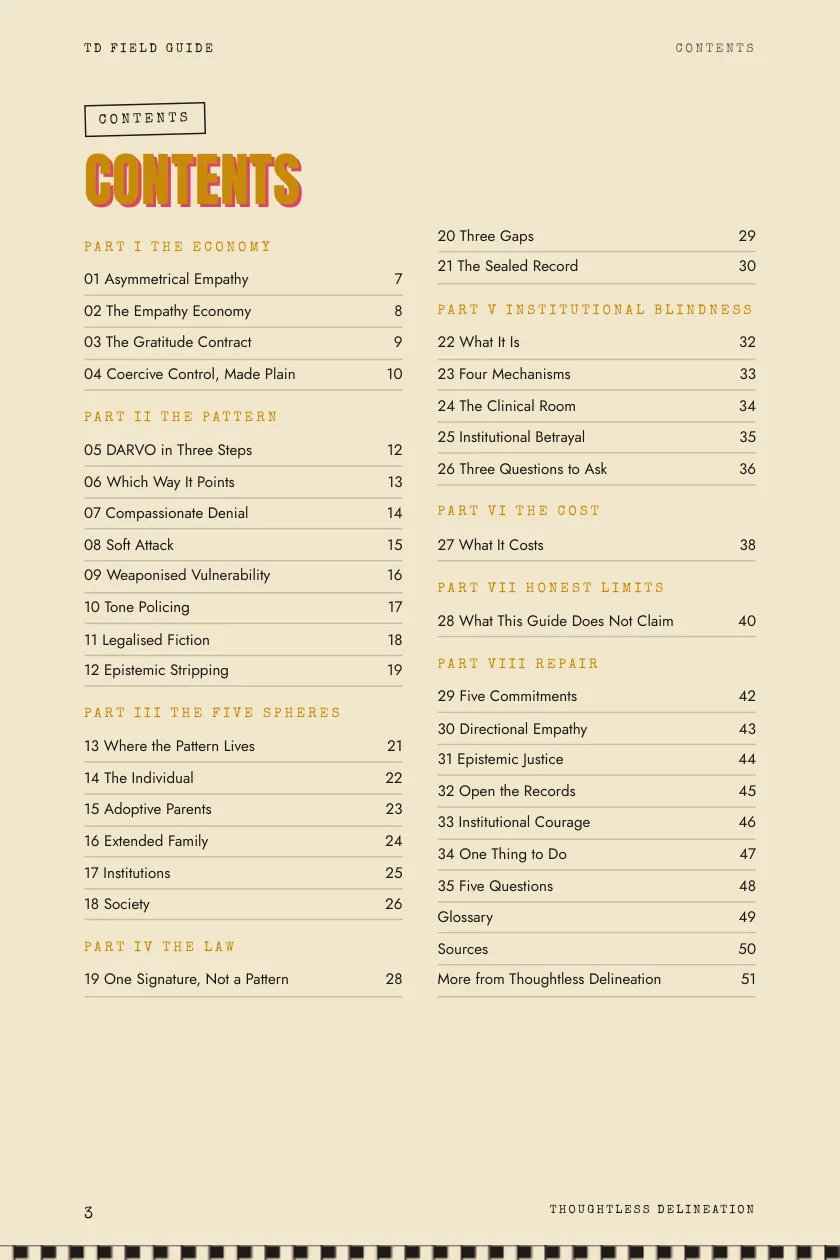
What’s inside
One pattern, followed in eight stages, from the family table to the courtroom and on to repair. Each stage builds on the one before, and each page is one idea.
- The economy (pp. 6–10). Who gets understood and who does the understanding: asymmetrical empathy, the empathy economy, the gratitude contract, coercive control made plain.
- The pattern (pp. 11–19). DARVO in three steps and which way it points: compassionate denial, soft attack, weaponised vulnerability, tone policing, legalised fiction, epistemic stripping.
- The five spheres (pp. 20–26). Where the pattern lives: the individual, adoptive parents, extended family, institutions and society.
- The law (pp. 27–30). Why the law sees a signature and misses a pattern; three gaps; the sealed record.
- Institutional blindness (pp. 31–36). Four ways a system turns harm into something it can handle; the clinical room; institutional betrayal; three questions to ask.
- The cost (pp. 37–38). What it does to a person and to a system.
- Honest limits (pp. 39–40). What the guide does not claim.
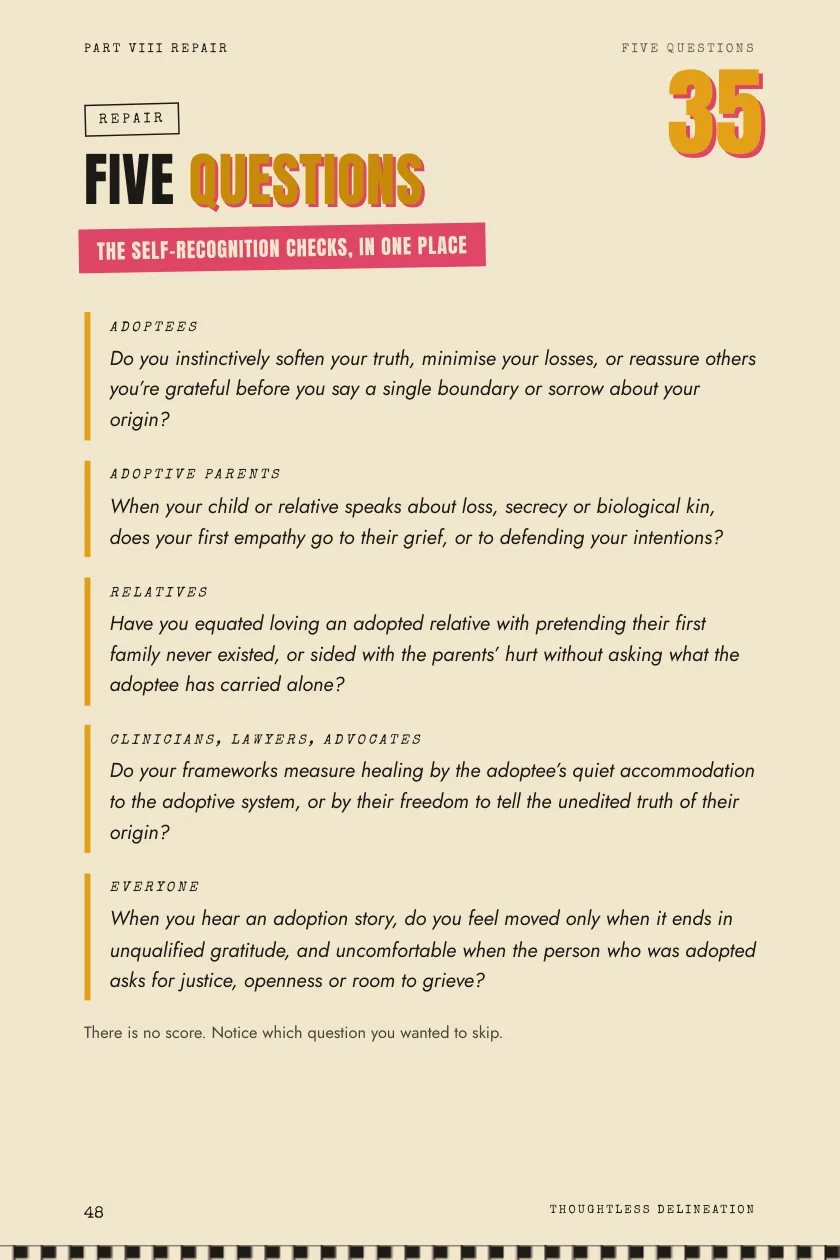
- Repair (pp. 41–48). Five commitments (directional empathy, care without a debt, epistemic justice, open records and better law, institutional courage), then one thing to do and five questions to ask yourself.
Every page follows the same steps: how it works, what it sounds like, a short note from the thesis, something to try instead, and the pages it connects to. It closes with a glossary, a sources list, and links to more of Shane Bouel’s work.
Sample page: Compassionate Denial
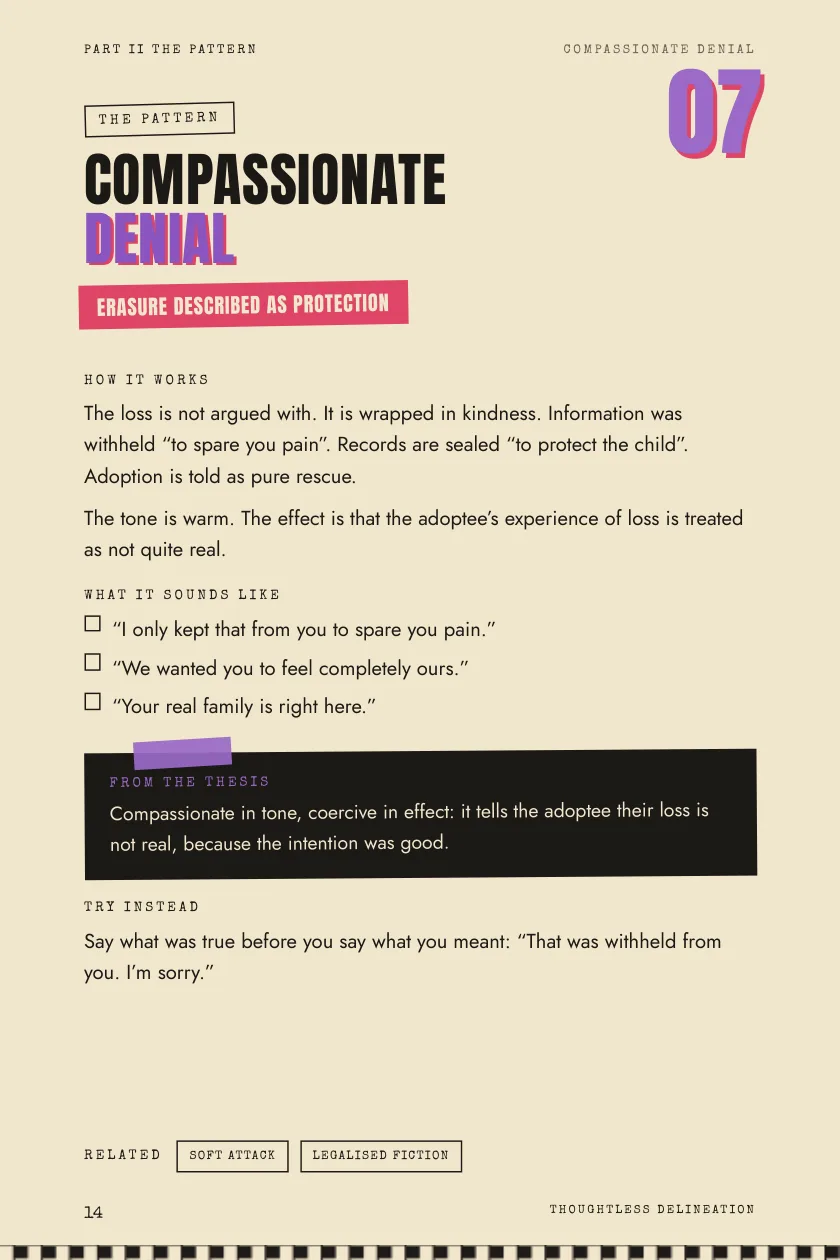
Compassionate Denial
How it works
The loss is not argued with. It is wrapped in kindness. Information was withheld “to spare you pain”. Records are sealed “to protect the child”. Adoption is told as pure rescue. The tone is warm. The effect is that the adoptee’s experience of loss is treated as not quite real.
What it sounds like
- “I only kept that from you to spare you pain.”
- “We wanted you to feel completely ours.”
- “Your real family is right here.”
Try instead
Say what was true before you say what you meant: “That was withheld from you. I’m sorry.”
Questions
What is asymmetrical empathy in adoption?
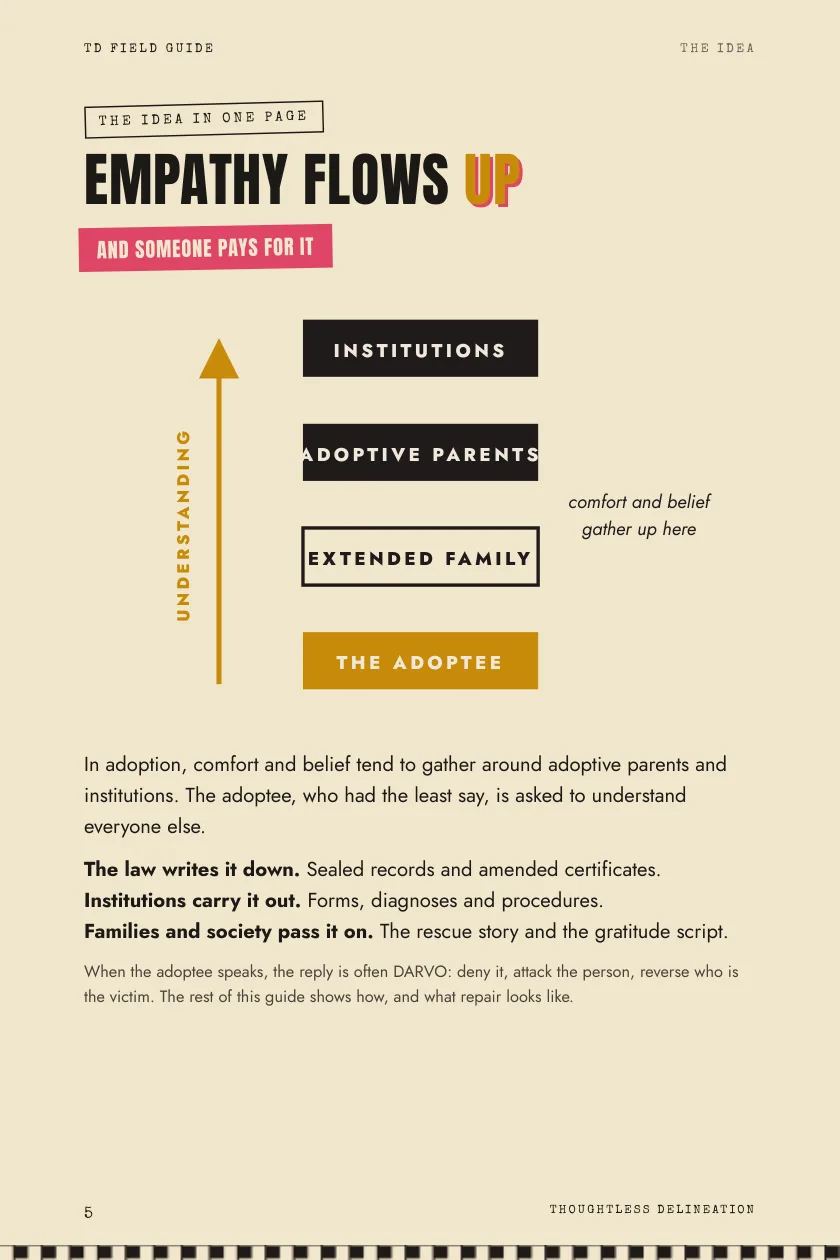
Understanding and protection that flow upward, toward adoptive parents and institutions, while the people with the least say, the adoptee and often the biological parent, are asked to give the most.
What is DARVO?
Deny, Attack, Reverse Victim and Offender, a pattern named by psychologist Jennifer Freyd in 1997. In adoption it tends to be aimed at the adoptee, not come from them.
What is the gratitude contract?
Care treated as a debt. Food, shelter, school and love are the basic duty of anyone who takes on a child. They are not a loan to be repaid with silence.
Does the guide say adoptive parents are bad people?
No. It describes patterns in systems and positions, not character. Most adoptive parents act out of love. A page in the guide lists exactly what it does not claim.
Is this a study?
No. It is a plain-language guide to a theory. It needs research to test how common these patterns are and what they lead to, and it says so.
Is it safe to read?
It is written to be taken slowly, one page at a time. If it stirs things up, in Australia Lifeline is on 13 11 14, any hour. Elsewhere, contact a local crisis line or someone you trust.
The first guide in the series, No. 01: The Machinery of Adoption, Named, covers seventeen frameworks. Full definitions are in the Framework Canon.